Cartoon Borders: Passports, Visas and Walls in Graphic Reportage
Table
2. Before leaving for the US: passport and visa as narrative devices
3. The border as a chronotope and builtspace: the West Bank Barrier
4. Conclusions: the chronotope of the border in graphic reportage
Abstract
Italiano | IngleseQuesto articolo esamina la rappresentazione del confine nel reportage a fumetti, una forma narrativa che combina pratica documentaria e testimonianza soggettiva e che offre un accesso privilegiato a luoghi in cui la fotografia incontra limitazioni: zone militari, checkpoint, aree di detenzione e frontiere geopolitiche. Il confine verrà inteso allo stesso tempo come «comics-builtspace» (Aldama) e come cronotopo (Bachtin), vale a dire come punto di accesso al luogo dell’indagine e come spazio di incontro tra mondi diversi (quello del reporter e quello visitato).
L’analisi si concentrerà su due fumetti italiani, Migrantes. Verso il sogno americano di Flaviano Bianchini e Giovanni Ballati (2019) e Tracciato Palestina. Racconto di viaggio in Cisgiordania di Elena Mistrello (2023). La rappresentazione del confine in queste opere sarà esaminata sia da una prospettiva storica (attraverso il confronto con New York New York di Sergio Staino, pubblicato nel 1984) sia da una prospettiva internazionale (con uno sguardo a How to Understand Israel in 60 Days or Less di Sarah Glidden, apparso nel 2011). Prendendo in esame la tematizzazione dei passaporti e dei visti e la rappresentazione del confine in quanto luogo fisico, questo articolo intende mostrare come nel giornalismo a fumetti l’attraversamento dei confini si configuri come un momento cruciale di rivelazione politica.
1. Introduction
During her journey through the West Bank, Elena Mistrello crosses numerous checkpoints and control zones. In Hebron, after showing her documents, she was given permission to pass the checkpoint and to enter the deserted Shuhada Street, once a vibrant market route. A family of settlers walks past her with proud, almost defiant posture; having witnessed settler violence, the author feels a surge of indignation. Her caption reads:
Non reagire, non guardare, non fissare, non dire niente… mi concentro, non posso fare foto… devo registrare informazioni… devo ricordare questa tensione, questa sensazione di orrore… non devo dimenticarla (MISTRELLO 2024: 47).1
There are still places where cameras cannot enter, and in such contexts hand-drawn journalism continues to play an essential role. As Hillary Chute notes in her discussion of Joe Sacco—one of the leading figures in contemporary graphic journalism—«Sacco’s work materializes histories from places where photography cannot travel» (CHUTE 2016: 210). This persistence of drawing as a documentary tool is particularly significant when viewed against the long rivalry between photography and drawing in the visual representation of reality.
Within this long-standing competition between photography and drawing over the visual representation of reality, graphic hand-drawn journalism has experienced alternating fortunes. Until the early twentieth century – before photography became cheap and printing processes advanced (GIPPONI, LOCATI, BOEMIA 2024: 25-38) – drawn reportage enjoyed a golden age (ROOB 2023). From the 1920s onward, however, photography dominated the graphic representation of events, relegating drawn reportage to the margins until the 1980s, when the referential status of photography was destabilized and «synthetic images» (SORLIN 1997) regained space. Since its revival, graphic journalism – «a type of journalism that uses comics to depict the news and other noteworthy nonfiction events» (PEDRI 2022: 43) – has adopted the reportage genre with enthusiasm. The border is one of the places on which this genre of documentary comics has focused most.
A reportage generally narrates two intertwined stories: the story of the reporter, who departs from the place where they live – and which they typically share with their readers – in order to travel to the site they intend to investigate, and the story of the visited place and its inhabitants (BOEMIA 2024: 12). In the most representative genre of contemporary comics journalism, in short, travel is a fundamental part of the narrative, and in this sense, the border is both a place and a narrative device.
As Maxim Samson has written, a border is simply «a dividing line, which is necessarily spatial and as such can be mapped» (SAMSON 2024). It is therefore no coincidence that comics journalism—and reportage in particular—frequently relies on maps of various scales and kinds (PEDRI 2014 and 2024). In comics journalism, the border takes on a far broader and more complex dimension: it is not only a geopolitical marker but a lived, narrated, and visually materialized threshold. The aim of this essay is to examine how comics enable us to reflect on borders by situating them within a narrative framework and graphic representation.
Many reportages suggest that the act of crossing a border in comics journalism can be interpreted through Bakhtin’s notion of the chronotope of the threshold, which is essentially «connected with the breaking point in life, the moment of crisis, the decision that changes a life» (BAKHTIN 1981: 248). It links the narrow, the confined, the private with the extensive, the public, the city. Linked with the notion of limen in Latin, a threshold is a liminal space that refers to a transitory, in-between state or space, characterized by indeterminacy, ambiguity, hybridity, and the potential for subversion and change. The chronotope of the threshold is generally associated with the motif of encounter, and this aligns with the idea of reportage as a form of crossover: the meeting between the reporter’s world and the world being visited, worlds that would never intersect without the journey and its narrative articulation.
According to Samson, «boundaries encapsulate humans’ engagement with the world in general: wanting to understand it, but also to shape it» (SAMSON 2024). This dual function resonates with the twofold role the border plays in comics reportage: on the one hand, a threshold the reporter must cross in order to gain access to and comprehend the ‘other’ world; on the other, a limit that shapes—and often restricts—the lived reality of those who inhabit it, sometimes turning into an oppressive, prison-like enclosure.
Beyond this narrative dimension of the border, there is also a material one, which presents the border as a builtspace: one that cartoonists, by virtue of drawing, are able to transpose onto the page as a «comicscape» (ALDAMA 2026), a drawn, materialized place whose visual articulation contributes to its political and symbolic meaning. In comics journalism, borders are not only described but depicted, rendered through line, shading, perspective, and layout. This visual construction turns the border into a site of narrative density, where aesthetic choices intersect with ideological ones. Maps, panoramas, liminal zones, checkpoints, and waiting areas become part of a graphic understanding of mobility and power. In combining the issue of the chronotope and the graphic dimensions, the essay aims to show how comics make borders thinkable: as narrative thresholds and as visualized spaces, simultaneously lived and drawn.
Contemporary Italian comics are rich in reportages structured around journeys and border crossings (BOEMIA 2024 and 2025); among these, however, two works stand out for placing the problem of the border itself at the explicit center of their narrative and formal construction: Flaviano Bianchini and Giovanni Ballati’s Migrantes. Verso il sogno americano and Elena Mistrello’s Tracciato Palestina. These two reportages constitute the core of the analysis because they place the border at the structural center of their narrative trajectories: in the first case, through the voluntary renunciation of citizenship privileges and the embodied experience of clandestine crossing; in the second, through sustained immersion in a territorially fragmented space dominated by walls and checkpoints. Both works foreground the material and political dimensions of the border while maintaining a first-person documentary perspective, making them particularly suitable for examining the border as chronotope and builtspace. The representation of the border in these works will be examined from both a historical perspective—through comparison with reportages such as New York New York by Sergio Staino (1984)—and an international one, including How to Understand Israel in 60 Days or Less by Sarah Glidden (2011).
Methodologically, the analysis combines narratological attention to the reporter’s trajectory (departure, access, crossing, waiting) with formal analysis of spatial construction in comics (page architecture, scale, perspective, and the interaction between text and image). These works are examined in their structural logic and in relation to key moments where the border becomes a decisive narrative and spatial device. The goal is to identify recurring formal strategies through which comics journalism renders border regimes visible and experiential.
I understand the border as a space that is simultaneously empirical and political (DI FAZIO 2022: 29): a concrete site shaped by everyday practices and, at the same time, a device that organizes and regulates them. The empirical dimension concerns what can be observed on the ground—interactions, material conditions, social dynamics—while the political dimension refers to the institutional frameworks and power relations that interpret and govern these practices. In the narrative representation of borders, however, these two dimensions intersect so closely as to become inseparable.
In short, the purpose of this essay is to explore the space dedicated to borders in graphic reportage, especially where borders cease to be abstract lines and take the concrete form of walls. The temporality of reportage differs markedly from that of news: reportage arrives when events have already unfolded or – in the case of war reportage – while they are unfolding, yet its focus is not on the event itself but on a condition, a situation, often one anchored in geopolitical dynamics. To narrate the border thus means to investigate a state of affairs that is sedimented, constructed, and explicitly denied full representation for security-related reasons. In the second section, I will therefore analyze the border through the lens of the representation of passports and visa as narrative devices: even before departure, the reportage can describe the relationship between the reporter's place of origin and their destination, and thus begin to discuss their freedom of movement. In the third section, I will turn to the border as empirical space, focusing in particular on its configuration as builtspace, on how it is represented in the form of a wall and how characters interact with it.
2. Before leaving for the US: passport and visa as narrative devices
The existence of a border creates the conditions that make a key necessary to open the gates of its passage points. According to Antony Galton, «physical boundaries such as walls usually include gateways or portals by which movement across the boundary is simultaneously facilitated and regulated» (151). The crossing of national boundaries is often regulated by a system of entry requirements, compelling prospective travelers to prepare in advance. Almost always, however, when borders take the form of walls, they are erected on only one side, in stark contrast to the bilateral systems of access regulations that typically govern cross-border movement. Unless you find yourself in a novel by Paasilinna — I am thinking of The Year of the Hare, in which the Finnish protagonist wanders through the woods and crosses the Russian border without even realizing it — crossing a border requires preparation. Today, that passage is opened by identification documents, such as a passport, and by a fee to be paid, the visa. For example, even Joe Sacco, before entering Palestine for the comic that would make documentary comics history, recounts having stopped at the city of Cairo, in Egypt, for a few days while waiting for his visa for Israel (SACCO 2006: 1-3).
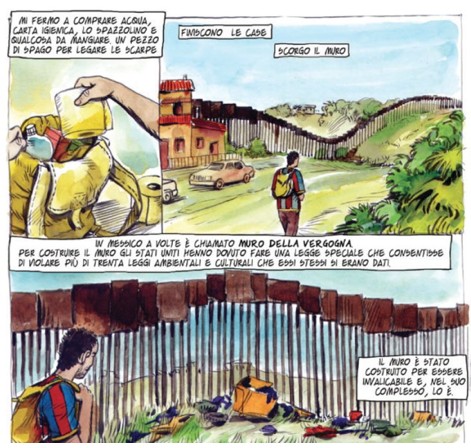
Closely related to the issue of borders is that of citizenship, an abstract and intangible status determined – depending on the legal framework – either by place of birth or by the nationality of one’s parents. Flaviano Bianchini and Giovanni Ballati argued that borders and the concept of citizenship are among humanity’s most violent inventions, as borders – often drawn by distant bureaucrats – divide families, peoples, and determine individual destinies (BIANCHINI, BALLATI 2018: 136). The two authors – Bianchini is the one who made the journey and Ballati is the one who turned it into a comic – talk about the passport as a shield, a form of protection. Depending on what is written on it, it takes you to different places, thus establishing our freedom of movement. When the reporter becomes a migrant without documents, his condition becomes very similar to that of people who hold a weak passport, such as many South Americans; to cross the border, he too must do so illegally (Fig. 1).
The most important thing at birth is not health or money, but something abstract that no one can see or touch. Depending on the law, it can be determined by place of birth or the nationality of the parents: citizenship. «La cittadinanza è colei che ti dà protezione, che ti dà sicurezza, che ti dà garanzie e diritti» (BIANCHINI, BALLATI 2022: 6), they argue.2 The document that establishes citizenship worldwide is the passport, which for Italian citizens is as follows: «[…] uno stupido rettangolo di cartoncino di un colore indefinito tra il marrone e il rosso bordeau. Dodici centrimetri per otto. Con una scritta in caratteri dorati: Unione Europea – Repubblica Italiana» (BIANCHINI, BALLATI 2022: 5).3 Flaviano Bianchini’s decision to abandon his shield – his Italian passport – and embark on a journey from Guatemala to the United States, passing through Mexico, is emblematic. He discarded his powerful Italian identity to embrace that of Aymar Blanco, a Peruvian sailor with ancient Basque ancestry, born in Pucallpa, in the heart of the Peruvian Amazon. Aymar’s journey begins on the border between Guatemala and Mexico, where he sends his Italian passport to friends in Mexico City and embraces his new identity.
The fact that a reportage can address issues related to the documents required for entry into a country is evident as early as the 1980s, when Sergio Staino recounted his journey to New York to the readers of the communist newspaper l’Unità. This stands as one of the earliest examples of Italian comics reportage, in which Staino narrates his fear of being denied a visa prior to his departure for New York in the summer of 1984. His anxiety was not unfounded: several prominent figures with communist affiliations had recently been refused entry. Although this form of reportage differs in nature, it nonetheless centers on the experience of a journalist attempting to enter the United States.
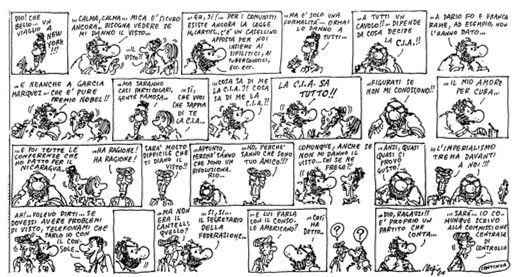
Source: Historical Archive of l'Unità https://archivio.unita.news/>.
Building on this initial exploration of perceptions and expectations, the narrative quickly shifts to the practical and symbolic obstacles of travel, showing how even obtaining a visa reflects broader political and ideological tensions. For communists of the time, McCarthy-era restrictions remained in effect («Per i comunisti esiste ancora la legge McCharty… c’è un casellino apposta per noi insieme ai sifilitici, ai tuber-colitici, ecc. ecc») (STAINO 1984),4 having barred entry to figures such as Dario Fo, Franca Rame, and Gabriel García Márquez. Staino/Bobo feared that the CIA might deny him a visa due to his support for Cuba and the numerous conferences he had given on Nicaragua (Fig. 2). In this context, obtaining a visa becomes an integral part of the travel narrative, as it embodies the asymmetries of power and ideology that shape the relationship between the country of origin (Italy) and the destination (USA). Far from a mere bureaucratic procedure, the visa directly engages with a central theme of travel reportage: the negotiation of cultural and political boundaries that precede—and determine—the possibility of crossing them.
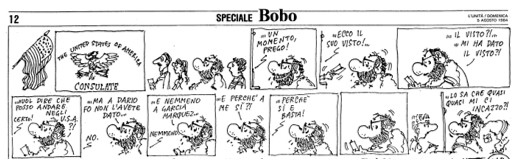
Source: Historical Archive of l'Unità https://archivio.unita.news/.
Bobo’s eventual and surprising visa approval (Fig. 3) is recounted with a mixture of anxiety and humor. Staino’s reportage begins at the American consulate in Italy, well before packing his suitcase. As the reportage is published in the daily communist newspaper l’Unità, Bobo shares his Italian passport and communist political beliefs with readers, so what applies to him also applies to his readers, transforming Bobo into a proxy traveler.
3. The border as a chronotope and builtspace: the West Bank Barrier
Comics construct environments—urban, domestic, or institutional—that shape how characters move, perceive, and experience the world. These spaces are never neutral: they organize narrative time, structure agency, and reflect social hierarchies and exclusions (ALDAMA 2026). Translating this to border reporting in comics, walls and checkpoints, can be read as builtspaces that regulate movement, embody power, and inscribe inequality, while the visual and sequential structure of the comic allows readers to experience these spaces bodily and temporally. Comics can render borders tangible, material, and affectively charged, turning the border itself into a narrative and political actor.
The West Bank barrier is a separation wall constructed by Israel beginning in the early 2000s, in the context of the Second Intifada, as a security measure aimed at controlling movement between Israeli and Palestinian territories. The barrier remains a highly contested and politicized structure, physically and symbolically dividing communities. Notably, Joe Sacco’s seminal work Palestine does not depict this barrier because his reportage was based on travels to the region before its construction. Consequently, the wall is absent from his narrative, despite its significant impact on the region’s contemporary geopolitical landscape.
Within graphic journalism, the barrier quickly becomes a central visual and narrative motif. It is one of the first things Sarah Glidden depicts in her travelogue. When she first sees it, she does not recognize it – it looks like a very long prison – but then she sees it clearly and identifies the wall. Glidden represents this moment of awareness by superimposing her reflection as she looks in horror at the wall from the bus window, with the wall depicted in a cartoonish style and fully colored with watercolors (Fig. 4). This private journey is guided by a Jewish tour guide, who explains that the barrier is a delicate matter: it is officially presented as a security measure, not a border (GLIDDEN 2010: 25). As such, it does not follow the Green Line – the boundaries of the state of Israel as defined in 1967 – but nonetheless it profoundly impacts Palestinian communities. The guide emphasizes the wall’s security purpose, while the cartoonist experiences increasing unease.
The West Bank Barrier functions as a constructed environment that both shapes and constrains human movement, perception, and experience. Like the U.S.–Mexico border wall, it materializes the abstract notion of a political and social divide, translating it into a physical form that imposes bodily, emotional, and psychological realities. The wall is not neutral (GRAGLIA 2019: 7): it organizes space to privilege some populations while restricting and surveilling others. In Glidden’s depiction, the contrast between the cartoonish, colorful rendering of the wall and her anxious reflection emphasizes the tension between representation and lived experience, showing how builtspaces operate as sites of exclusion and ethical reflection.
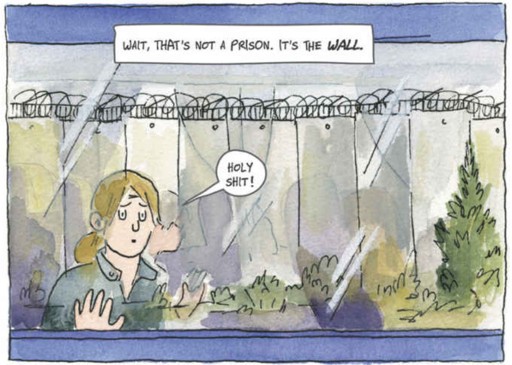
DC Comics, New York 2010 (excerpt).
This becomes even clearer in Cristina Petrucci and Zerocalcare’s depiction of Palestine in October 2007, in his graphic reportage consisting of a four-page comic that recounts a meeting between the Palestinian women’s national football team and a group of Italian female players (BOEMIA 2024: 8). Published in XL (a supplement of the newspaper la Repubblica), the comics entitled Sport sotto l’assedio documents a trip to Palestine undertaken by the eponymous project, which sought to meet the Palestinian team—itself split in two by the wall built by Israel and consequently divided between Gaza and the West Bank. From its opening panels, the comic positions itself in contrast to the official narrative promoted by the Israeli state and reproduced in much Western media. The cartoonish depiction of the wall emphasizes it as a mechanism of division, not only between Israeli and Palestinians but also between Palestinians of different regions (Gaza and West Bank).5 The wall is even drawn to include a map of Palestine, guiding the reader to perceive how the state of Israel itself functions as a barrier separating Gaza from the West Bank.
The wall is also central to the much long Tracciato Palestina, published in September 2023 and produced with the support of the social center FOA Boccaccio in collaboration with the West Climbing Bank project. The comics recounts the author’s journey, together with other activists from the social center, through the West Bank as part of another initiative that combines popular sport and solidarity by introducing Palestinian youth to rock climbing. Through a first-person narrative, Mistrello documents ten days in Palestine: from the anxiety of security checks at Tel Aviv airport to the warm welcome in Dheisheh, the Palestinian refugee camp south of Bethlehem where the youth association Laylac is based. According to Lisa Maya Quaianni Manuzzato, in Tracciato Palestina the importance of reclaiming space is embedded in the very purpose of the trip (QUAIANNI MANUZZATO 2024: 149). They want to bring solidarity and to regain, at least in part, control over the territory – even if only through the preparation of climbing routes – in the face of a nation acutely aware of the strategic centrality of its borders.
This work of spatial reclaiming finds a stark counterpoint in Mistrello’s visual rendering of the West Bank barrier (Fig. 5). In the full-page illustration, the wall dominates the composition to such a degree that it expels almost every other visual element: it rises vertically, heavy and unyielding, filling the frame with coarse pencil strokes that mimic the roughness of poured concrete. The reader encounters the wall much as the narrator does: suddenly, overwhelmingly, without any mediating distance, from a worm's-eye view. The sheer scale is accentuated by the upward tilt of the perspective, which forces the eye toward the looming watchtower on the right, a structure that visually seals the scene and underscores the asymmetry of power embedded in the architecture of occupation.
In the representation of the wall, we see what Hillary Chute describes as «the immediacy of the drawn line» (CHUTE 2016: 262): an urgency and subjectivity that convey not only the act of witnessing but also the simultaneity and fragmentation characteristic of traumatic perception. The wall becomes both a material object and an affective surface, registering the narrator’s oscillation between knowing and not knowing, between political awareness and stunned disbelief. The density of hatching used to render the concrete panels further contributes to this effect: the repetitive vertical strokes evoke monotony and enclosure, but they also emphasize the labor of drawing itself. In this sense, Mistrello’s representation participates in what Chute identifies as the capacity of comics lines to unfurl embodied witness.
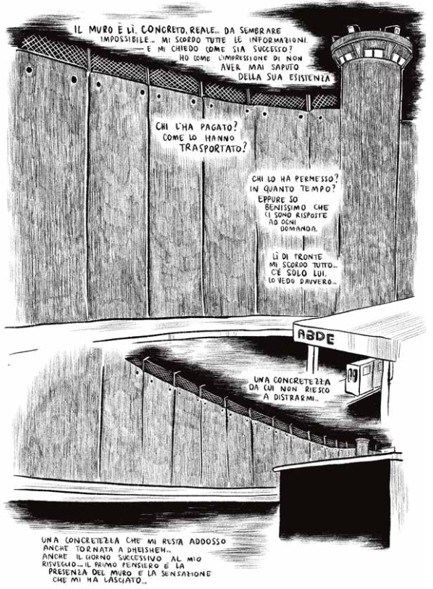
FOA BOCCACCIO 003, Monza 2024, p. 15.
The lower half of the page extends this encounter with the barrier by shifting to a more distanced, panoramic view, yet the sense of entrapment only deepens. The wall snakes across the composition in a long, uninterrupted curve similar to those of the American wall, emphasizing its territorial reach and its capacity to reshape the landscape itself. The checkpoint structure appears as a functional appendage of the wall’s machinery, reinforcing the systemic nature of control. The dense hatching grows even darker here, pooling into deep shadows that visually anchor the wall’s concreteness, a term («concretezza») the narrator uses repeatedly to describe the lingering weight of this sight.
According to Hillary Chute, «Drawing someone carefully is a form of dwelling […] in the space of that person’s body, taking on their range of postures that themselves reflect experience» (CHUTE 2016: 249). We might add that drawing something carefully is also a way of coming to understand its proportions and contours, of attending to the place it occupies in the world. It entails recognizing that it was created with a purpose, and that its presence in the world is already shaping the experience of others. This attention to the material and affective weight of built structures becomes particularly evident when cartoonists depict the act of crossing them.
Emblematic is the border crossing represented by Elena Mistrello in Tracciato Palestina, depicting the well-known Checkpoint 300, one of the main access points to Jerusalem, linking it to Bethlehem. Tourists never pass through here on foot, entering instead from another gate by bus. In this way, by renouncing the privileges guaranteed by her citizenship, Mistrello is doing something similar to what Flaviano Bianchini did to enter the United States. Two splash pages (Fig. 6) convey the chaos that precedes the turnstiles. Mistrello represented the dense crowding of bodies, the skewed perspective, and the overwhelming accumulation of speech balloons work together to immerse the reader in a space defined by compression, noise, and uncertainty.
On the left-hand page (p. 34), the ceiling’s harsh geometry and surveillance cameras frame the mass of people from above, reinforcing a sense of enclosure and control. Israeli flags hang from the wall, giving that passage political connotations. The composition funnels the viewer’s eye toward the closed turnstile – an immovable point around which the restless crowd surges – thus spatializing the temporal suspension experienced by those waiting. The right-hand page (p. 35) intensifies this effect through a series of tightly cropped faces, each marked by fatigue, frustration, or resignation. Here, the visible background disappears entirely. This absence is striking precisely because the wall and its material presence have dominated the earlier pages: at the moment of greatest tension, the built environment recedes, swallowed by the press of bodies. The erasure of the setting mirrors the reporter’s disorientation and underscores that, in such conditions, the border no longer appears as an external structure but becomes an embodied experience of compression. The dialogue between the cartoonist and the activist Elio Catania multiplies the dramatic effect of the graphic representation («E poi la sera sono costretti a tornare indietro tardi, rientrano a casa, e via, la notte successive di nuovo in fila all’alba. Sfiniti e sfruttati…»),6 placing that moment in a cyclical pattern of exploitation.
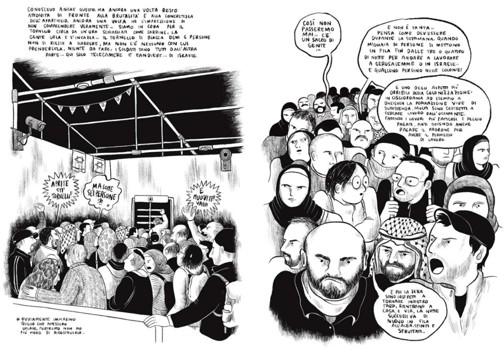
FOA BOCCACCIO 003, Monza 2024, pp. 34-35.
4. Conclusions: the chronotope of the border in graphic reportage
This essay has examined the border as both political space and empirical space, as visual representation and narrative device in graphic reportage. Through a set of selected case studies, it has identified recurring formal strategies rather than proposing an exhaustive typology of border representations in comics journalism. This focused analysis leads to a definition of the border as a threshold chronotope: a zone of encounter, friction, revelation, and political meaning. In the works explored, crossing the border constitutes a decisive narrative event, shaping the reporter’s trajectory and framing the conditions of visibility that structure the reportage.
There are a number of elements that characterize this sub-type of the threshold chronotope, the border chronotope: movements occur predominantly in a single direction (from the poorer area toward the richer one, which is also the side that built the wall); time becomes dilated in inverse proportion to the narrowing of space, which is crowded and noisy. Often marked by a flag—and thus grounded in a nationalist imaginary—the border is regulated by largely unilateral agreements. Piero S. Graglia argues that all barriers erected throughout human history are different, yet they share a single characteristic: they are built according to the will of one party alone (GRAGLIA 2019: 7). Those who wish to cross must comply with the regulations and present the required documents. In order to narrate the chronotope of the border in the first person, comics artists blend into the crowd (as Mistrello does), at times even relinquishing the shield of their passport (as in the case of Bianchini).
We have seen that the wall is not merely a line on a map but a materially constructed space that shapes movement, experience, and narrative. The wall permits only two types of movement: one may either pass through it or walk alongside it, following its often imposing length. The first form of movement is regulated by the rules discussed above, while the second amounts to a kind of aimless wandering. The wall embodies inequality, violence, and political control, and together with deserts, checkpoints, and related infrastructures, it creates a dense spatial network through which the reporter must navigate.
Comics journalism, capable of entering spaces forbidden to cameras, uses drawing to bear witness to hidden infrastructures of control: walls, gates, checkpoints, documents, surveillance regimes. By analyzing passports and visas, the border emerges as a site where identity is negotiated and sometimes temporarily suspended. As builtspace, cartoon borders expose global inequalities: between occupier and occupied, citizen and noncitizen. As narrative device, the border is not simply crossed, but it is performed and contested.
Bibliographie
Monografie
BAKHTIN M. M., The Dialogic Imagination: Four Essays. Trans. Caryl Emerson and Michael Holquist. Ed. Michael Holquist, University of Texas Press, Austin 1981.
CHUTE H. L., Disaster Drawn. Visual Witnes, Comics, and Documentary form, The Belknap Press of Harvard University Press, Cambridge, Massachusetts - London, England 2016.
DI FAZIO C., Acqua come frontiera. Politiche per una nuova cultura della mobilità umana, Fondazione Giangiacomo Feltrinelli, Milano 2022.
GLIDDEN S., How to Understand Israel in 60 days or less, DC Comics, New York 2010.
GRAGLIA P. S., Il muro. Berlino e gli altri, People, Gallarate 2019.
MISTRELLO E., Tracciato Palestina. Racconto di viaggio in Cisgiordania, FOA BOCCACCIO 003, Monza 2024.
PEDRI N., A Coincise Dictionary of Comics, illustrated by Chuck Howitt, The University Press of Mississippi, Jackson 2022.
ROOB A., The History of Press Graphics 1819‑1921, Taschen, Cologne 2023.
SACCO J., Palestine, Fantagraphics Books, Lake City Way Ne, Seattle, Wa 2006.
SAMSON M., Invisible Lines: Boundaries and Belts That Define the World, House of Anansi Press, Toronto 2024 (l’edizione consultata è in formato Kindle).
SORLIN P., Les fils de Nadar: le "siècle" de l'image analogique, Nathan Université, Paris 1997.
Curatele e articoli in volumi collettivi
ALDAMA F. K., «Builtspaces, Intersectional Identities, and Comics», in PEDRI N., Comics and Intermediality, The University Press of Mississippi, Jackson 2026. Forthcoming.
BOEMIA D. «A Critical Overview of Italian Comics Journalism (2002-2022)», in ALETTA A., Italian Comics in the New Millennium. Vol. 2. New Scenarios, New Forms, New Themes, Vernon Press, Wilmington, DE 2025, pp. 61-80.
GIPPONI E., LOCATI S., BOEMIA D., «Dall’illustrazione al fototesto. Il rapporto tra testo e immagine nei periodici», in BOEMIA D., GIPPONI E., LOCATI S., Immagine e testo nei periodici illustrati italiani degli anni trenta e quaranta, Mimesis, Milano-Udine 2024, pp. 19-46.
PEDRI N., «Bridging Worlds: Infographics, Maps, and Photographs in Graphic Novels», The Routledge Companion to Literature and Art. Routledge, Abingdon, England-New York, NY 2024, pp. 467-479.
QUAIANNI MANUZZATO L. M., «“Autoproduzione dell’impegno” nella produzione contemporanea italiana: il caso di Tracciato palestina», in Gruppo SnIF, For Real. Il fumetto italiano tra realtà e realismo, Franco Cesati, Firenze 2024, pp. 145-151.
Articolo su rivista‑giornale
BOEMIA D., «The Lives of Others and My Own Life. Reportage in Italian Comics Journalism», Italian Studies, 79.4, 2024.
PEDRI N., «Re-Visualizing the Map in Guy Delisle’s Pyongyang», Aborescences: Le dispositif texte/image, 4, 2014, pp. 99-114.
STAINO S., «New York (Chapter 1)», l’Unità, 5 August 1984, p. 11.
STAINO S., «New York (Chapter 2)», l’Unità, 5 August 1984, p. 12.
Note
↑ 1 «Don’t react, don’t look, don’t stare, don’t say anything… I focus, I can’t take photos… I have to record information… I have to remember this tension, this feeling of horror… I must not forget it». The English translations of the Italian text are mine.
↑ 2 «Citizenship is what gives you protection, security, guarantees, and rights».
↑ 3 « […] a stupid rectangle of cardboard, of an undefined color somewhere between brown and burgundy. Twelve centimeters by eight. With a title in gold lettering: European Union – Italian Republic».
↑ 4 «For communists, the McCarthy law still exists… there’s a little box specifically for us, along with the syphilitics, the tuberculosis patients, and so on».
↑ 5 See Petrucci C., Zerocalcare, «Sport sotto l’assedio», Repubblica XL, ottobre 2007. The 4-page comic is available at the following link: https://freepalestine.noblogs.org/post/2010/11/21/zerocalcare-per-la-palestina/ (accessed on 6 March 2026).
↑ 6 «And then in the evening they are forced to go back late, they return home, and again, the next night back in line at dawn. Exhausted and exploited».